Why Your Gutters Matter to Your Roof
Gutters look like trim, but they decide where every gallon of roof runoff goes, and a clogged run can rot the fascia it hangs from.
September 30, 2026 · 4 min read
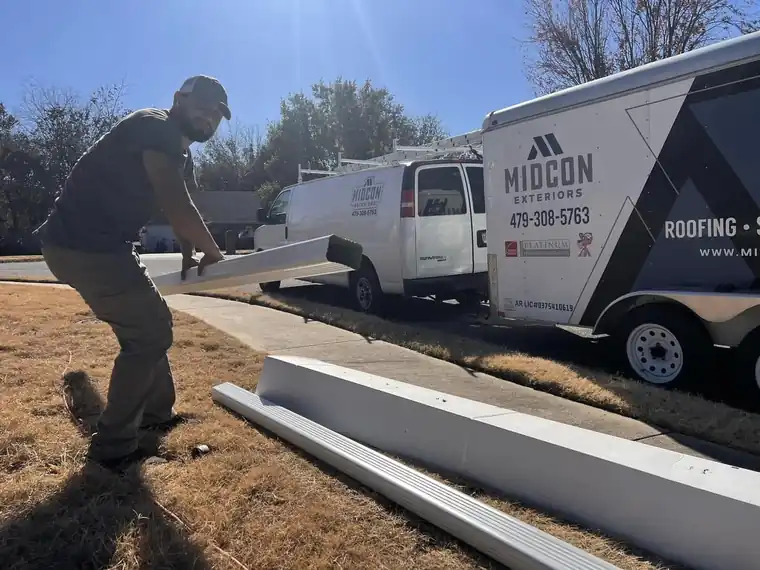
Most people think of gutters as an accessory, something bolted on after the roof is finished. In practice the roof and the gutters are one water system. The roof collects rain, the gutters carry it to the downspouts, and the downspouts get it away from your house. If any link is undersized or clogged, the water goes somewhere you did not plan for, and that somewhere is usually your fascia, your siding or the ground beside your foundation.
Here is how to size a system properly, why downspouts matter more than most people assume and how to pick a guard that suits the trees around your Northwest Arkansas home.
What happens when gutters fail
The fascia board is what the gutter hangs from. When water overflows onto it again and again, the wood softens and rots, and the hangers lose their grip.
Leaves, pine needles and roof grit build up over a season. Once a downspout clogs, water backs up and spills over the front edge instead of draining away. That is right where it can damage the fascia board, the siding and the soil around your foundation. A well-maintained system does the opposite: it protects the foundation from pooling water, protects exterior walls, windows and doors, and reduces the chance of mold and mildew.
5-inch or 6-inch gutters?
Gutter size comes down to a handful of variables: the roof's runoff area, how steep the roof is, the number of downspouts and the length of the run. The size of the house matters less than how much roof is draining into each section.
- 5-inch gutters are the most commonly installed size and are sufficient for most residential homes when they are designed with the right number of downspouts. They are sized to your runoff area and downspout count.
- 6-inch gutters are a larger K-style profile for homes with wider fascia or steep roof slopes that shed a lot of water. Much like wider crown molding inside, the bigger profile suits a bigger exterior, and it relieves heavy runoff where slopes are large and steep.
Not sure which one your house needs? We walk the roofline and tell you honestly whether the upgrade is worth it. Sometimes it is not.
Oversized downspouts do the quiet work
Many builder-grade installations use small 2-inch by 3-inch downspouts. We use oversized 3-inch by 4-inch downspouts on both our 5-inch and 6-inch systems, standard on every install. The larger opening drains water faster and helps flush debris through elbows and connections instead of letting it collect and clog.
If you already have gutters that overflow during a heavy rain even though they are clean, downspout capacity is often the reason. An upgrade to larger downspouts is something we can add to an existing system.
Seamless aluminum and hidden hangers
Seamless aluminum gutters are the most popular system for good reason. Aluminum does not rust, it is lightweight and it comes in factory-finished colors to match shingles, soffit and fascia trim. Because the runs are formed to length, there are fewer seams to leak.
How the gutter is fastened matters too. Older systems were nailed through the front of the gutter into the fascia with spikes. We hang ours with hidden hangers fastened with screws, which gives a cleaner look and lets the hangers be adjusted during installation so that water drains properly.
Guards, screens and micro-mesh
Cleaning gutters is a task nobody enjoys. Guards cut down how often it is needed, but no single guard is right for every yard. The best choice depends on what is falling on your roof.
- Perforated hi-temper aluminum guards are built for high water flow and heavy debris coming off a roof.
- Gutter screens are small-hole (1/16 inch) powder-coated steel, an economical option where larger leaves are the main problem.
- Micro-mesh is stainless steel that filters out roof grit, pine needles and leaves, and it also deters mosquitoes, wasps and other pests from moving into your gutters.
Northwest Arkansas yards have plenty of trees. If the main problem is larger leaves from hardwoods, a screen is often the practical pick. If you have pine trees or a lot of fine debris, micro-mesh is usually worth the upgrade. Tell us what grows near the house and we will recommend a guard.
Repair before replacement
Not every gutter problem means a whole new system. Sagging sections, hangers that have pulled away from the fascia, leaking seams at corners and runs that have lost their pitch are all fixable, often without a full replacement. If the gutters are too old or too damaged to be worth repairing, we will say that too and point you toward replacement.
Correct the pitch, reseal the corners and re-hang sagging sections, and a tired system often goes back to work. Check the fascia behind it too.
Put the roof and the gutters on one checklist
Our free roof inspection includes a look at the gutters and downspouts for proper drainage, alongside shingles, flashing, vent boots and attic ventilation. That is deliberate. Roofs and gutters fail in the same storms, and it is cheaper to see both at once. After hail, dented gutters and downspouts are often the first clue that the roof took the same hit.
Midcon Exteriors installs seamless aluminum gutters, guards, screens and micro-mesh, and also handles gutter repair and cleaning, across Lowell and the rest of Northwest Arkansas.
The takeaway: size the gutters to the roof, use oversized downspouts and pick the guard to match your trees. A free inspection from our team will tell you which of those your home needs.
Midcon Exteriors, (479) 308-5763
Call (479) 308-5763More articles
NWA Storm Damage: What Homeowners Need to Know
A storm is over in minutes, but what you do in the next two days and the next two years decides how well your roof and your claim hold up.
Roofing FAQs: Your Top Questions Answered
Real answers on cost, claims, materials, financing and cleanup, from a Lowell roofing crew that gets these questions every week.